
MA crossover
Two moving averages: the fast one reacts to price quickly, the slow one shows the general direction. When the fast average crosses the slow one upward the robot sees a rise starting, and when it crosses downward, a fall.
Choose a platform: MT5 shows the chart and Inputs screenshots from MetaTrader 5, MT4 shows the chart with entries and the Inputs screenshot from MetaTrader 4.
How the robot trades
When it buys
The fast average crosses the slow one upward.
When it sells
The fast average crosses the slow one downward.
When it exits
A buy closes when the fast average drops below the slow one; a sell closes when it rises above it.
Screenshot 1 of 5
The conditions as constructor blocks
Open a buy
Open a sell
Close a buy
Close a sell
Inputs
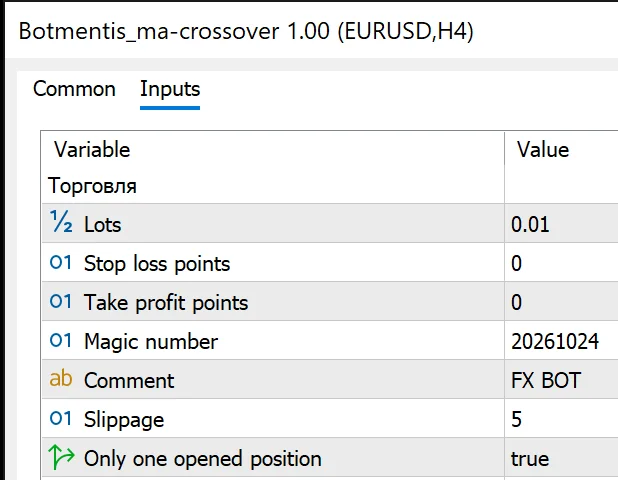
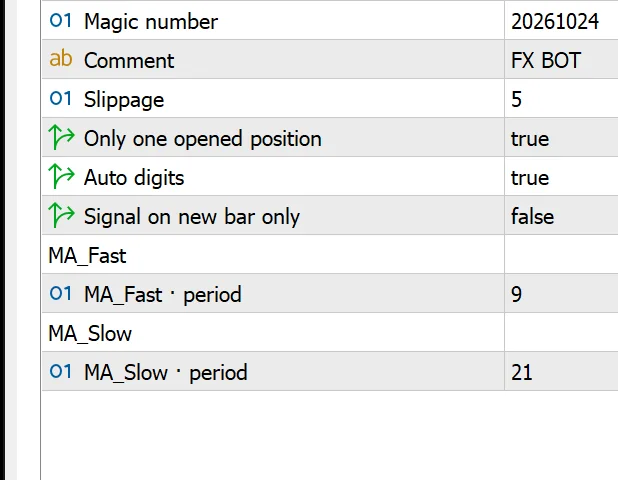
These inputs appear in the expert advisor settings in MetaTrader 5 or MetaTrader 4, and they are what the strategy tester goes through when it optimises the robot.
| Input | Default | What it means |
|---|---|---|
| InpMA_Fast_period | 9 | Period of the fast average: how many recent candles it averages. |
| InpMA_Slow_period | 21 | Period of the slow average: the larger it is, the calmer the line and the rarer the signals. |
How to tune the robot to your style
- Change the periods of the averages and watch how the number of signals changes.
- Switch the averaging method or the price used in the indicator properties.
- Add a second condition, such as an RSI filter, to skip some of the signals.
You can do all of this in the constructor without signing up. To save your changes and come back to them later, you need an account.
Risks
How a strategy behaved in the past does not predict its future results. Check the robot in the strategy tester and on a demo account first, and only then decide whether to trade it with real money. This robot is an example to adapt to your instrument, timeframe and risk rules.